Quick summary (TL;DR)
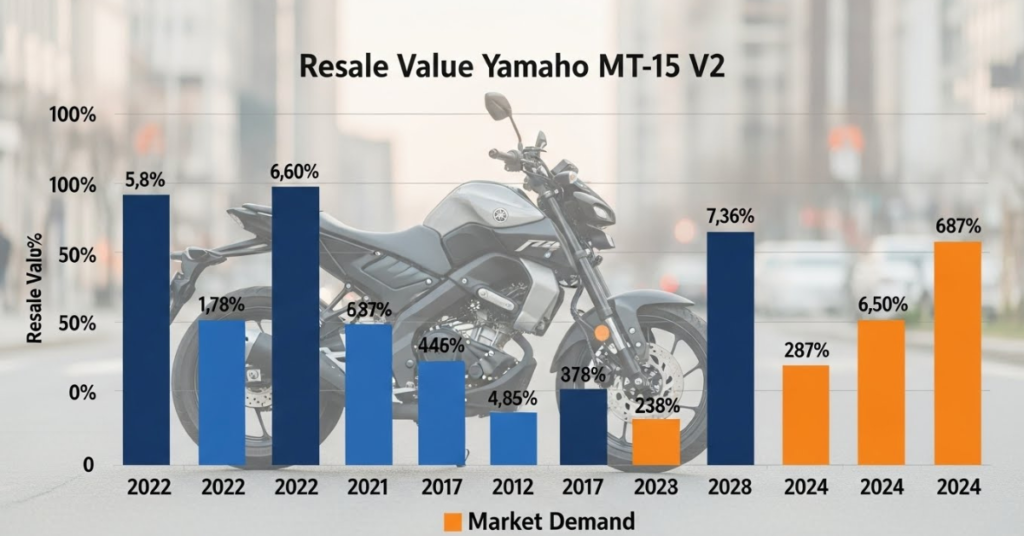
The Yamaha MT-15 V2.0 is a popular compact streetfighter: attractive design, punchy 150cc engine and Yamaha’s brand backing. The 2025 Version 2.0 launch (and Yamaha’s warranty and pricing moves) keeps demand healthy for used MT-15s. Expect significant early-year depreciation (insurance/IDV rules suggest 15–30% in the first 2 years depending on age, kms and condition), but well-maintained MT-15s hold value better than many generic commuter bikes due to desirability among young buyers and enthusiasts. Market listings and valuations show typical used asking prices in India between ~₹90k (older/high-km examples) and ₹1.6L (near-new, low-km 2023–2024 bikes); up-to-date valuation tools and classifieds confirm this range. (The Economic Times)
1 — What is the MT-15 V2 and why it matters for resale
The Yamaha MT-15 is Yamaha’s compact “streetfighter” in the 150cc class. The V2 (Version 2.0) refreshes styling and retains the high-revving 150cc single-cylinder engine that enthusiasts like for responsiveness and a sporty feel. In 2025 Yamaha launched the MT-15 Version 2.0 with updated features and a refreshed price bracket, which renewed interest in both new and used examples. New model launches and manufacturer initiatives (like extended warranty programs) tend to buoy resale values because they strengthen brand perception and make used purchases feel safer. (The Economic Times)
Why this matters for resale:
- Sporty models that attract young buyers and first-time performance seekers maintain demand.
- Feature updates and price changes for the new model can shift used-bike price ceilings and buyer expectations. (The Economic Times)
2 — Current retail & used price snapshot (India, 2024–2025)
Understanding resale starts with the new-bike price (price ceiling) and active used listings (market reality).
New/ex-showroom (representative 2025 figures): MT-15 Version 2.0 ex-showroom pricing was announced in 2025 around ₹1.69 lakh (STD) to ~₹1.80 lakh (DLX) depending on variant and state taxes. This is the starting anchor for depreciation math. (The Economic Times)
What used listings and valuation tools show:
- Valuation engines (Orange Book Value / Gearz) report typical used MT-15 V2 valuations in the range of ~₹1.25L–₹1.42L depending on year and condition for recent model years. (Orange Book Value)
- Classifieds (OLX, BikeWale, Bikes4Sale) show active asking prices that range broadly: older, higher-km bikes appear under ₹1.0L; low-km 2023–2024 examples often list between ₹1.2L and ₹1.6L. Regional supply/demand drives specific numbers — metro cities typically show higher used prices. (OLX)
Takeaway: realistic resale expectations depend heavily on model year, ownership history, kilometres ridden, service history, cosmetic condition, and any transferable warranty or accessories.
3 — How much value does an MT-15 lose — depreciation explained
Officially, vehicle depreciation used for insurance IDV calculations follows standard insurance/IRDAI scales (age-based). For practical resale planning, here’s a commonly used framework in India (used by insurers and valuation services):
- Under 6 months: ~5% depreciation
- 6 months – 1 year: ~15%
- 1–2 years: ~20%
- 2–3 years: ~30%
- 3–4 years: ~40%
- 4–5 years: ~50% (and beyond, negotiated) (TATA AIG)
What that means for the MT-15: because the MT-15’s new price sits around the ₹1.6–1.8L mark (2024–25 models), a 1–2 year old MT-15 in good condition could realistically sell for roughly 70–80% of its ex-showroom price (adjusted for on-road and variant differences), while older/higher-km examples can drop to 50% or lower depending on wear and market interest. Valuation engines and classifieds confirm used asking bands near those percentages. (Orange Book Value)
4 — Demand drivers for MT-15 used market
Several factors shape the market demand for MT-15s:
- Youth & style appeal: The MT series’ aggressive styling and upright streetfighter ergonomics attract younger riders and first-time sports-bike buyers — a steady demand segment for used MT-15s.
- Performance and practicality balance: The 150cc platform is fun but still economical enough for daily commutes — widening the buyer pool.
- Brand & service network: Yamaha’s nationwide service reach and spare part availability reduce buyer anxiety for used purchases. Yamaha’s extended warranty programs (when available) can be transferable and boost used-bike appeal. (The Economic Times)
- New model refreshes: Ironically, a new version (V2) can both depress older trims (if supply surges) and increase demand if the refresh draws buyers to the model family. In 2025 the V2 launch refreshed interest in the MT-15 line. (The Economic Times)
- Rival availability & pricing: Competitors like KTM Duke 125 / other 150cc sporty offerings influence buyer choices; sometimes a cheaper used rival will pull demand away. (BikeWale)
5 — Real-world price examples & platforms (how to read listings)
Active classifieds (OLX, BikeWale, Bikes4Sale) and valuation tools (OrangeBookValue, Droom, Gearz) are the two primary places to research market pricing:
- Classifieds show actual asking prices — they tell you what sellers hope to get, and you’ll see a spread by condition and city. Example listings for MT-15 V2 years 2021–2024 show asking prices between ~₹80k to ₹1.55L depending on kms and condition. (OLX)
- Valuation tools (OrangeBookValue / Droom) provide algorithmic estimates and a quick sanity check on fair pricing by year and odometer. They’re not final sale prices but help set reasonable expectations. (Orange Book Value)
When comparing, account for:
- On-road vs ex-showroom price differences across cities.
- Transferable warranty (if Yamaha’s program applies) — this can add a premium in buyer eyes. (The Economic Times)
6 — MT-15 vs rivals — resale strength comparison
Comparing resale strength is useful if you want to trade or evaluate long-term value.
- KTM Duke 125 (and similar small Dukes): KTM tends to carry a “premium/enthusiast” badge, but maintenance perceptions and higher service costs sometimes reduce resale for budget buyers. The MT-15 often competes well on perceived value (sporty looks + lower perceived running cost), so resale remains healthy for MT-15. (BikeWale)
- Other 150cc sport/commuter bikes: Generic commuter bikes (e.g., Pulsar/Apache 160 class) may depreciate less in absolute percentage because of mass demand, but the MT-15 commands a higher absolute price if it’s well-maintained because of its niche performance appeal. (BikeWale)
7 — Top factors that make or break MT-15 resale value
If you want a high resale, focus on these (in order of impact):
- Service history & bills: Full service records with dealer stamps are the #1 trust signal. Buyers pay more for a documented history.
- Kilometres ridden (odometer): Lower km = higher price. For MT-15, under ~15–20k km for a 2–3 year old bike is ideal for better pricing.
- Single ownership / no accidents: Clean ownership and no major repairs meaningfully boost asking price.
- Cosmetic condition: Scratches, bent levers, replaced panels — these kill perceived value. Even small panel damage can cost you 5–15% on the sticker price.
- Modifications: Tasteful bolt-on accessories are okay; heavy performance mods or illegal modifications often reduce value because many buyers prefer factory condition.
- Tyres, chain & brake condition: Replacing near-worn consumables before sale improves negotiating power.
- Transferable incentives/warranties: If Yamaha’s extended warranty or any transferable package applies (e.g., festival offers or limited-time warranty extensions), mention it — it’s a buyer magnet. (The Economic Times)
8 — How to maximize your MT-15’s resale price (practical checklist)
If you’re selling, follow this checklist to maximize final sale value:
Pre-sale prep:
- Get a dealer/service center full service and keep all bills. A pre-sale dealer inspection report is useful.
- Fix small cosmetic issues (lever, mirror alignment, dents). Buyers notice neatness.
- Replace consumables if cheap to replace (chain set if noisy/worn, brake pads, battery).
- Deep clean and photograph the bike in daylight from multiple angles (close-ups of odometer, service stamp, VIN). Good photos raise conversion.
- Keep original accessories and the user manual/keys (factory extras add trust).
Pricing and listing:
- Start with valuation tools (OBV/Droom) to set a realistic asking price; list ~5–10% higher than your target room for negotiation. (Orange Book Value)
- Upload clear service history screenshots, odometer, and actual photos to listings (OLX/BikeWale/Bikes4Sale).
- Be transparent about issues — hiding problems kills trust and delays sale.
Communication & negotiation:
- Respond quickly and be ready for short test rides with ID proof and refundable deposit.
- Highlight transferable warranty (if available) and recent major services. (The Economic Times)
9 — Where to sell: pros & cons of main channels
- Dealer trade-in: Fast and convenient, but dealers offer lower than private sale price (they need margin). Good if you want to buy new immediately.
- Online classifieds (OLX, Quikr): Wider audience, can push price higher but expect haggling and scammers. Use verified contact and in-person meetings in safe locations. (OLX)
- Certified used-bike platforms (Droom, BikeWale used section, Bikes24, Cars24 two-wheeler): Offer inspection and quicker sales for a fixed fee — less hassle, slightly lower net price. Droom also lists TCO/valuation info. (Droom)
10 — Negotiation benchmarks (practical numbers, example)
These are example bands (illustrative; check local listings for exact numbers):
- Near-new (2023–2024 models, <10k km, single owner, showroom serviced): ₹1.2L – ₹1.55L (asking), final ~85–95% of asking possible. (OLX)
- Well-maintained 2–3 year old (15–30k km): ₹90k – ₹1.2L (asking), expect final around 80–90% of ask. (OLX)
- Older / high km / with visible wear: ₹60k – ₹95k asking (negotiable), final often lower if mechanical work is needed. (OLX)
Use OrangeBookValue and local classifieds as your immediate reality check for city-level variations. (Orange Book Value)
11 — Common buyer questions & seller answers (quick scripts)
- Buyer: “Any insurance left?” — Seller: “Yes, valid until [date]. I’ll provide RC, insurance copy, and service bill; transfer process done at RTO or via online portal.”
- Buyer: “Any accident history?” — Be honest: small drops vs major frame repairs are different; disclose.
- Buyer: “Why are you selling?” — Keep it short and plausible: “Upgrading/relocating/work commute changed.” Honesty helps.
12 — Risks & watchouts for buyers and sellers
For buyers:
- Beware of odometer tampering (less common but check service stamps across years).
- Check for evidence of frame repair or welding (major accidents lower long-term value).
- Ask for a test ride and listen for gearbox/engine noises and check brakes thoroughly.
For sellers:
- Don’t overprice based on emotion (your new purchase price doesn’t equal market price). Use valuation tools and comparable listings. (Orange Book Value)
13 — Future outlook: will MT-15 resale stay strong?
Short-term (12–24 months): healthy. The 2025 V2 launch and Yamaha’s brand moves (warranty programs, pricing adjustments) support steady demand; younger riders continue to favour sporty 150cc machines. (The Economic Times)
Medium-term (2–4 years): depends on two things — how Yamaha prices future variants and whether rival affordable performance bikes enter the market. The MT family is well-positioned as long as service/support and parts availability stay strong.
14 — Useful resources (where to check live prices & valuations)
- Valuation / price check: OrangeBookValue, Gearz, Bikes4Sale, Droom. (Orange Book Value)
- Classifieds: OLX, BikeWale used, local Facebook groups, Quikr. (OLX)
- News / model updates: Times of India / Economic Times auto sections for new model launch & pricing changes. (The Times of India)
15 — FAQ (short)
Q: What percentage of price will an MT-15 lose in the first year?
A: Insurance/IDV and market data indicate roughly 15–20% in year one (age + usage dependent). Use OBV/Droom for precise numbers for your city. (TATA AIG)
Q: Does Yamaha’s extended warranty help resale?
A: Yes — transferable warranties or manufacturer programs boost buyer confidence and can increase realized sale price. Yamaha announced extended warranty initiatives recently. (The Economic Times)
Q: Is it better to sell privately or trade-in?
A: Private sale usually nets higher cash; dealer/trade-in gives convenience and immediate credit toward a new purchase. If you prioritize cash, sell privately or use certified platforms. (Droom)
16 — Closing — final checklist for sellers & buyers
If you’re selling: get service history, clean & fix small issues, check valuation tools, list with good photos, highlight transferables (warranty/insurance). Expect negotiation — price slightly above target.
If you’re buying: verify service records, check for accidents, confirm transferability of insurance/warranty, test ride, and compare local listings before you make an offer.
Sources & further reading (selected)
- Economic Times — 2025 Yamaha MT-15 V2 launch & pricing. (The Economic Times)
- Times of India — MT-15 Version 2.0 launch coverage (2025). (The Times of India)
- OrangeBookValue — Used Yamaha MT-15 V2 valuations. (Orange Book Value)
- OLX / BikeWale — active used listings for MT-15 showing asking prices and ranges. (OLX)
- Droom — Total cost of ownership and resale related data. (Droom)
- Insurance / IDV resources (ICICI Lombard, PolicyBazaar) for depreciation tables used in insurance valuations. (TATA AIG)