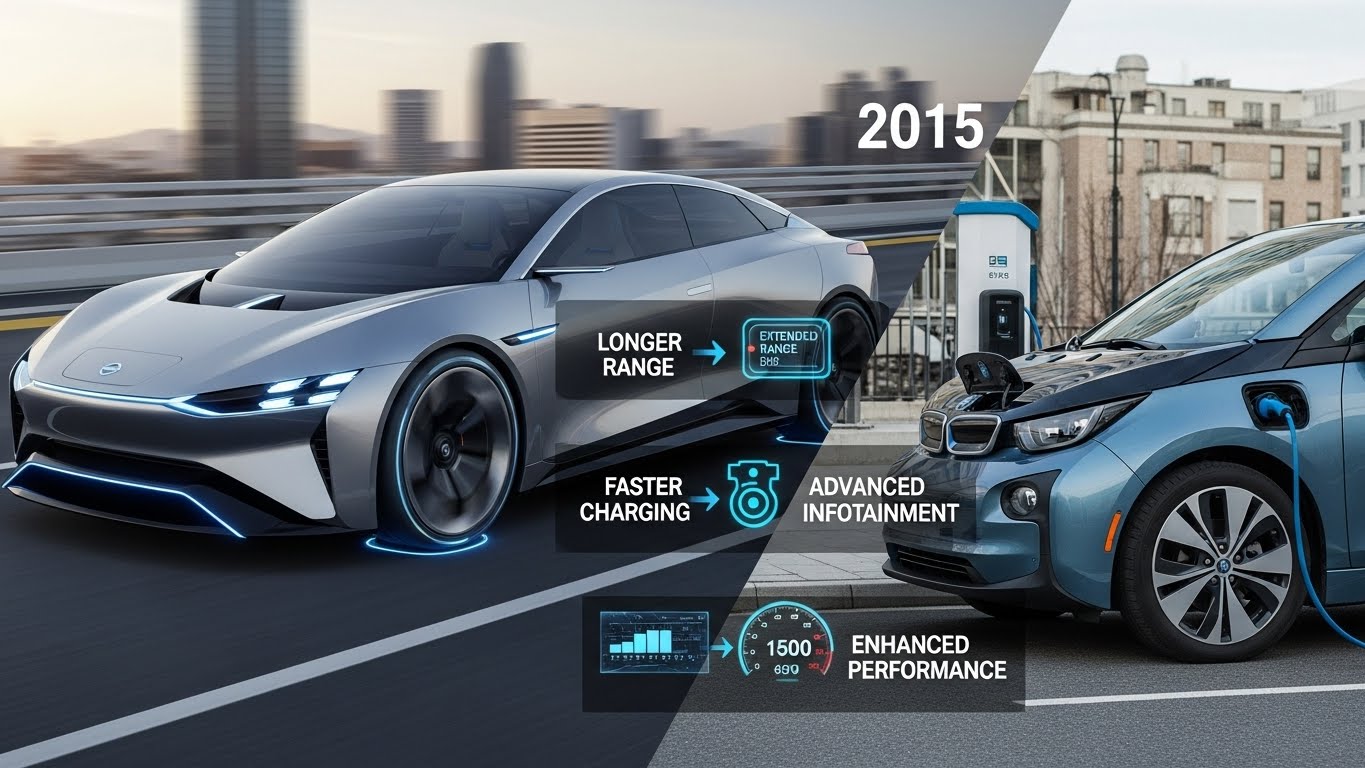
Upcoming EV cars launching around 2025 are not just “newer versions” of the same thing – they are a big step up from the first and second generation of electric vehicles that came out between 2010 and 2020. If you compare an older EV like an early Nissan Leaf or first-gen mass-market models to today’s 2025 line-up, almost everything has improved: range, charging speed, battery life, safety, software and even lighting technology. (The Electric Car Scheme)
This detailed, AdSense-friendly article explains what has changed in 2025 models, how they compare to older EVs, and whether it’s worth upgrading if you already own an electric car.
Older EVs vs 2025 Models: What Are We Comparing?
To understand the improvements, it helps to define both sides clearly.
When we say older EVs, we usually mean:
- First and second generation mainstream EVs sold roughly between 2010 and 2020.
- Typical real-world ranges of about 100–200 km for early cars, going up to around 250–300 km for some later models. (The Electric Car Scheme)
- 400 V electrical systems, slower fast-charging, limited ADAS, smaller screens and less sophisticated software.
By contrast, upcoming and current 2025 EVs generally offer:
- Average claimed ranges around 450–500 km for many new models, with some premium cars going far beyond that. (The Electric Car Scheme)
- Much faster DC charging speeds thanks to 800 V architectures and high C-rate batteries. (The Electric Car Scheme)
- Better thermal management, longer battery life, stronger safety features and far more advanced driver assistance.
Now let’s look at the improvements area by area.
1. Range: The End of Real “Range Anxiety”
In the early 2010s, many EVs struggled to go even 150 km on a full charge in real-world conditions. A first-generation Nissan Leaf, for example, was rated at around 73 miles (about 117 km) of range. (The Electric Car Scheme)
By 2025, the picture is very different:
- Studies show that the average EV range has increased by more than 140% over the past decade, with many 2025 models easily crossing 300 miles (about 480 km) on a single charge. (The Electric Car Scheme)
- Premium EVs now regularly claim 400–500 miles (640–800 km) under ideal test conditions, especially from brands focusing on long-range grand tourers. (The Electric Car Scheme)
What made this possible?
Battery energy density has improved dramatically. In 2015, mainstream EV packs were around 140 Wh/kg, whereas some 2025 batteries exceed 300 Wh/kg, meaning far more energy stored in the same weight and size. (The Electric Car Scheme)
For a buyer, this means:
- Daily commute plus errands with plenty of range left.
- Longer road trips with fewer charging stops.
- Less stress about running the battery too low.
Older EV owners who were constantly calculating every kilometre will find 2025 models much more relaxed and practical to live with.
2. Charging Speed and Architecture: From “Plan Your Day Around It” to Coffee-Break Fast
Early EVs could use fast chargers, but “fast” often meant 40–60 minutes to go from 20% to 80%, and the network itself was patchy. Many cars used 400 V systems and relatively modest charging rates.
In 2025, things have moved forward in two big ways:
- Ultra-fast public chargers: In some markets, ultra-rapid chargers can add 180–200 miles (290–320 km) of range in about 18 minutes. (The Electric Car Scheme)
- 800 V platforms and high C-rate packs: Cars like the Zeekr 001 and XPeng P7+ use high-voltage systems that allow 10–80% charges in roughly 12–20 minutes under ideal conditions. (Wikipedia)
The difference between an older EV and a 2025 model is simple:
- With an older car you often had to plan long stops and even your overnight stays around charging.
- With a 2025 EV, a quick bathroom break and coffee is often enough to get you back on the road with hundreds of kilometres added.
Of course, this depends on your local infrastructure, but the technology inside the cars is clearly far ahead of earlier generations. Global reports also show a rapid increase in public charge points and ultra-rapid stations. (The Electric Car Scheme)
3. Battery Health and Warranty: Better Chemistry, Slower Degradation
One of the biggest questions older EV owners have is: “Will my battery last?”
Data from large fleets show that real-world battery degradation is slower than many people fear. Across 10,000 EVs, the average degradation rate is around 1.8% per year, meaning most cars retain the majority of their range for more than a decade. (Geotab)
What has changed in recent years is that:
- Modern packs use improved lithium-ion chemistry and smarter battery management systems.
- Manufacturers explicitly design for lower degradation and offer long warranties, often around 8 years or 160,000 km on the battery. (ScienceDirect)
Compared to many older EVs, where early degradation was often steeper and warranties more conservative, 2025 models give buyers:
- More confidence in long-term ownership.
- Better resale value, because capacity loss is slower and well-documented.
- Lower risk of expensive out-of-warranty battery work.
If your existing older EV has lost a noticeable chunk of its range, a 2025 upgrade can feel like starting fresh with a more durable pack.
4. Performance and Efficiency: More Power Without Wasting Energy
At first, most EVs were either efficient but slow, or fast but heavy and pricey. Getting both performance and range together was rare.
New 2025 EVs are changing this balance:
- Studies show that manufacturers are optimising the relationship between battery size, weight, acceleration and top speed, using advanced models to get better range without sacrificing performance. (Nature)
- Facelifted EVs like the updated Toyota bZ4X get larger batteries, more powerful motors and higher estimated range in 2025 compared with earlier versions, while offering smoother driving and better interiors. (Wikipedia)
In practical terms, this means:
- Strong 0–100 km/h times even on “normal” trims.
- Better highway efficiency thanks to improved aerodynamics and more efficient motors.
- Fewer compromises between a fun driving experience and long-distance capability.
Older EVs may still feel quick off the line – electric torque hasn’t changed – but 2025 models are more refined, stable and efficient at speed.
5. Safety and ADAS: From Basic Aids to Semi-Autonomous Support
Earlier EVs often had standard safety like ABS, airbags and sometimes simple cruise control or lane departure warnings. That was it.
In 2025, safety and driver assistance are a major selling point:
- Surveys show that manufacturers consider safety, range and charging to be key areas where battery technology and electronics will keep improving. (Tata Consultancy Services)
- New EVs are shipping with sophisticated ADAS packages, including lane centring, adaptive cruise control, automatic emergency braking, traffic sign recognition and sometimes hands-free driving on mapped highways. (Wikipedia)
Systems like Huawei ADS 4.0 on some Chinese EVs use a mix of cameras, radar and LiDAR to support semi-autonomous driving in both city and highway conditions. (Wikipedia)
For the driver, the difference vs older EVs is significant:
- Safer long journeys with the car helping to keep you in lane and maintain distance.
- Extra protection in emergencies with smarter braking and collision avoidance.
- More relaxed commutes when ADAS is used correctly and the driver stays attentive.
6. Design, Lighting and Comfort: EVs Become Rolling Tech Lounges
Early EV interiors were often quirky or basic: small or medium screens, hard plastics, limited ambient lighting and simple audio systems.
In 2025, the focus has shifted to making EV cabins feel like premium tech spaces:
- Lighting technology has exploded with pixel arrays, matrix headlights and OLED taillights that not only look spectacular but can also project information, adjust patterns intelligently and use less energy. (TechRadar)
- Cars like the Voyah Free offer large panoramic roofs, high-end sound systems and advanced ambient lighting, turning the cabin into a comfortable lounge. (Wikipedia)
New 2025 models also address earlier complaints:
- Larger, higher-resolution infotainment screens with better UX and sometimes physical knobs brought back for climate or volume, as seen in updated EVs like the bZ4X. (Wikipedia)
- More ergonomic seating, quieter cabins and improved ride quality thanks to refined suspension tuning and better noise insulation.
Compared with older EVs, which sometimes felt like “beta versions” inside, upcoming cars feel more complete and mature.
7. Software, Connectivity and OTA Updates: Cars That Keep Improving
One of the biggest invisible upgrades from older EVs to 2025 models is software.
Modern EVs run complex operating systems:
- The Zeekr 001, for example, uses Zeekr OS 6.0 with a large OLED centre screen and AR head-up display, giving a highly digital driving environment. (Wikipedia)
- The XPeng P7+ receives OTA updates that can increase its range and improve functionality without any hardware change. (Wikipedia)
For buyers, this means:
- Features can be added or refined over time, not just at the time of purchase.
- Bugs and usability issues can be fixed via software updates.
- Navigation, charging recommendations and route planning can improve as networks grow.
If you own an older EV with outdated navigation or limited app support, the software experience in a 2025 model will feel like jumping several smartphone generations at once.
8. Charging Ecosystem and Ownership Experience: From Early Adopter to Mainstream
Improved cars only tell half the story. The ecosystem around them has also matured:
- Some countries now report tens of thousands of public charge points, including a rapidly growing number of ultra-fast chargers. (The Electric Car Scheme)
- Surveys show that EV owners mainly care about charging speed, location and convenience, and prefer reliable providers they can return to. (PwC)
- Analysts expect 2025 to be a pivotal year, with EVs potentially reaching around a quarter of new car sales in some markets. (Virta)
For you as a driver, this translates to:
- Easier long-distance planning with more charging options available.
- More apps and platforms that show real-time charger status and prices.
- Better integration between the car’s navigation, charging networks and payment systems.
Owning an EV in 2025 simply feels less “experimental” and more like a normal car with some extra steps.
9. Cost of Ownership and Value: Why Newer EVs Make More Financial Sense
EVs can offer strong lifetime savings:
- One large analysis found that switching to an EV can save around $15,900 over the vehicle’s life, mainly due to cheaper energy and lower maintenance. (Geotab)
Manufacturers also know that buyers worry about resale value and technology ageing quickly. That is why newer models come with:
- Better battery warranties and clearer degradation data. (Tata Consultancy Services)
- Software-based upgrades that help keep the car competitive for longer. (Wikipedia)
Older EVs were sometimes seen as a risky bet financially, especially if they were early models with smaller packs. 2025 EVs provide more transparency and better long-term confidence.
Should You Upgrade From an Older EV to a 2025 Model?
The answer depends on your situation, but here are some good reasons to consider moving to one of the upcoming 2025 EVs:
- Your current car’s range no longer fits your daily or highway needs.
- Public charging in your area has improved and you want to take full advantage of fast-charging.
- You value ADAS, safety upgrades and modern software features like OTA updates, advanced navigation and better infotainment.
- You want a car that will hold its range and value better over 8–10 years.
On the other hand, if your older EV still covers your daily routes easily, you have convenient home charging and you don’t care much about the latest tech, you may be able to keep it for several more years without major issues.
But for many drivers, 2025 models represent a major leap – not just a facelift – making them a smart time to switch from an aging first- or second-generation EV to a far more capable and future-proof car