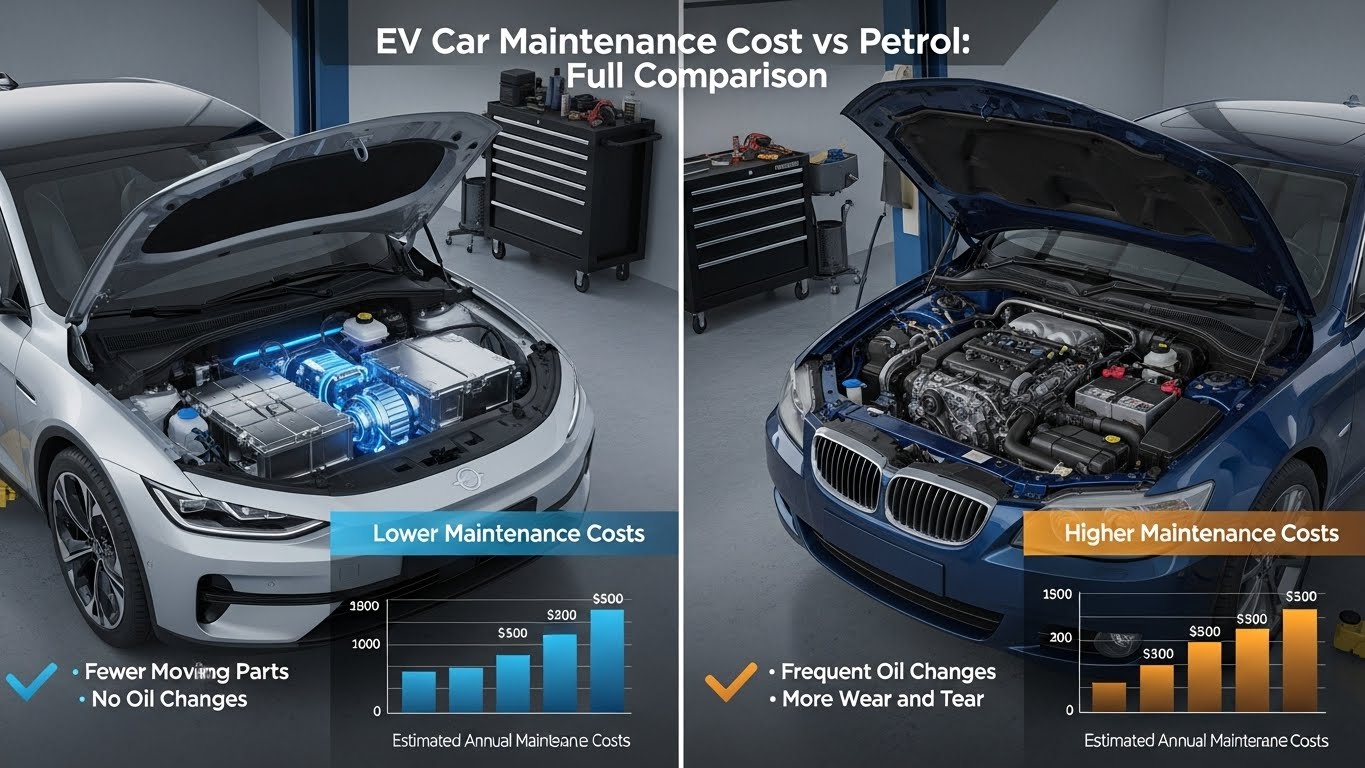
EV Car Maintenance Cost vs Petrol Car: Full Comparison
Electric vehicles (EVs) are becoming increasingly popular in India due to rising petrol prices, lower running costs, and government incentives. But one question still remains common among new buyers: Are EVs cheaper to maintain than petrol cars?
In this detailed comparison, we break down service cost, part replacement, fuel cost, long-term ownership cost, battery maintenance, and more to help you understand which option suits your budget and lifestyle.
1. Overview: EV vs Petrol Car Maintenance
Maintenance cost plays a major role in long-term ownership. Petrol cars have engines with hundreds of moving parts—pistons, valves, fuel pumps, spark plugs, oil filters, and more. EVs run on an electric motor with fewer than 20 moving parts, which instantly reduces servicing needs.
Key Difference
- EV cars → Lower maintenance cost, fewer services, no engine oil
- Petrol cars → Frequent servicing, higher wear-and-tear parts
On average, an EV’s annual service cost is 40–60% cheaper than that of a petrol car.
2. Routine Service Cost Comparison
Electric Cars
EV servicing is simpler. The major checks include:
- Battery health inspection
- Brake system check
- Tyre rotation
- Cooling system inspection
- Motor and wiring check
- Software update
Average annual EV service cost in India: ₹1,500 – ₹4,000
Petrol Cars
Petrol cars require:
- Engine oil change
- Oil filter replacement
- Air filter replacement
- Fuel filter replacement
- Spark plug replacement
- Emission testing
- Engine tuning
Average annual petrol car service cost: ₹6,000 – ₹12,000
Premium models can go up to ₹15,000 – ₹25,000 per service.
3. Fuel vs Electricity Cost Comparison
Petrol Cost
Petrol price in most cities: ₹100 – ₹110 per litre
A petrol car typically gives:
- City: 12–15 km/l
- Highway: 15–20 km/l
If you drive 1,000 km per month, fuel cost is:
- (1,000 km / 15 km/l) = 67 litres
- 67 × 105 = ₹7,000+ per month
Yearly petrol cost: ₹84,000+
Electricity Cost
EVs consume around 10–12 units per 100 km (varies by car).
Electricity rate (home charging): ₹7 – ₹10 per unit
If you drive 1,000 km per month:
- Units needed: 100–120
- 120 × ₹8 (avg) = ₹960 per month
Yearly electricity cost: ₹12,000 – ₹15,000
Fuel Cost Saving with EV:
₹70,000+ saved per year only on running cost.
4. Part Replacement & Wear-and-Tear Cost
EV Car Parts
EVs have fewer parts, so replacement is rare:
- Brake pads (last 1.5–2x longer due to regenerative braking)
- Tyres
- Wiper blades
- Cabin air filter
Average yearly cost: ₹2,000 – ₹5,000
Petrol Car Parts
Petrol models require regular part replacements:
- Engine oil (every 10,000 km)
- Oil filter
- Air filter
- Fuel filter
- Spark plugs
- Timing belt
- Clutch plates (manual cars)
Annual wear-and-tear cost: ₹6,000 – ₹25,000
EVs save 50%–70% on replacement parts.
5. Battery Maintenance Cost in EVs
This is the biggest question EV buyers ask—Is EV battery replacement expensive?
Battery Life
Modern lithium-ion batteries last:
- 8–10 years or
- 1.5 lakh – 2 lakh km
Replacement Cost
Varies by car:
- Tata Nexon EV: ₹4 lakh – ₹5 lakh
- MG ZS EV: ₹6 lakh – ₹7 lakh
- Hyundai Kona: ₹5 lakh – ₹6 lakh
But most manufacturers offer:
- 8-year / 1,60,000 km battery warranty
So replacement is rarely needed within ownership period.
Battery Maintenance Tips
- Avoid charging to 100% daily
- Avoid deep discharge below 10%
- Park in shade
- Use slow/home charging often
6. Long-Term Ownership Cost: 5-Year Comparison
Let’s assume 1,000 km/month usage (12,000 km/year).
EV Car (Example: Tata Nexon EV)
- Maintenance: ₹3,000 × 5 = ₹15,000
- Electricity: ₹14,000 × 5 = ₹70,000
- Total 5-year cost = ₹85,000
Petrol Car (Example: Hyundai i20 Petrol)
- Maintenance: ₹9,000 × 5 = ₹45,000
- Fuel: ₹84,000 × 5 = ₹4,20,000
- Total 5-year cost = ₹4,65,000
5-Year Savings with EV:
₹3,80,000+ saved
Even if battery replacement is needed after 8 years, the overall cost is still lower than petrol ownership.
7. Insurance Cost Difference
EV Insurance
- Higher IDV (car value is higher)
- More coverage for battery
Annual premium: 15–25% higher than petrol cars.
But the higher premium is easily recovered through fuel savings.
Petrol Insurance
Regular insurance with standard rates.
8. Charging Cost vs Fast Charging Cost
Home Charging (Cheapest)
- ₹7–₹10 per unit
- ₹1 – ₹1.2 per km
Public Fast Charging
- ₹18 – ₹26 per unit
- ₹2.5 – ₹3 per km
Still cheaper than petrol cars where cost per km is:
- ₹6 – ₹9 per km
9. EV Maintenance Advantages
1. No Engine Oil
You save on:
- Oil
- Oil filter
- Labour charges
2. Fewer Moving Parts
Reduces chances of breakdown.
3. Longer Brake Life
Regenerative braking increases lifespan.
4. Software Updates Improve Performance
Remote or service-centre updates.
5. Lower Pollution & Noise
Zero tailpipe emissions and smooth drive.
10. Petrol Car Maintenance Advantages
To be fair, petrol cars also have some advantages:
- Fuel stations everywhere
- Quick refuelling
- No battery degradation worries
- Low initial purchase price
- More resale buyers (currently)
11. Which Is Better for You?
Choose EV If:
- You drive more than 1,000–1,500 km/month
- You want extremely low running cost
- You can install home charging
- You plan to keep the car for 5–10 years
- You want eco-friendly mobility
Choose Petrol Car If:
- You drive less than 800 km/month
- You travel long highway distances often
- You don’t have access to home or office charging
- Budget is limited
12. Final Verdict: EV vs Petrol Car Maintenance Cost
EVs clearly win in terms of:
- Running cost
- Annual service cost
- Part replacement cost
- Long-term savings
Petrol cars cost 4–5 times more to run yearly compared to EVs.
If you want lower spending, smooth driving, and future-proof technology, an EV car is the best choice. For long-distance convenience and quick refuelling, petrol cars still hold an advantage.